Sandwell Metropolitan Borough Council: local authority assessment
Downloads
Overall summary
Local authority rating and score
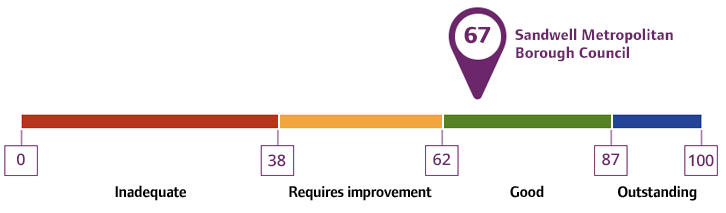
Quality statement scores
Summary of people’s experiences
People’s experience of care and support was primarily positive in that they were involved throughout in decisions which were incorporated into care planning. People could share feedback and were able to contact the local authority where needed. Some staff were described by people as genuine and wanting to make positive changes to people’s lives. However, other people had fewer positive experiences of the approach taken by some staff during assessments. Other issues people raised included having to repeat information to different staff. Delays for assessment for some people had caused stress and anxiety, however other people told us about better experiences.
People were given help, advice and information about how to access services, facilities and other agencies for help with non-eligible care and support needs. However, feedback from people around this was mixed. People told us being given inconsistent information about care and respite or that information had not been given at all.
People were supported to have their cultural needs met with the care provided. However, feedback about inclusion and accessibility included people not feeling arrangements were always accessible for them, for example, information was not always translated into their preferred language, or people were not always clear they could request this.
People had mixed views about their experiences of care. One person told us they were happy with their flat at a local authority extra care facility where their independent living skills had increased. Other people struggled to find information about care, felt there were a lack of options available to them and they believed that some care agencies did not always have the training required to support them well.
Feedback about a 12-Week Pathway for people with a learning disability and/or autism was consistently positive, for example, in building people’s skills and confidence and successfully linking them with community groups. People had been engaged in co-production activities in relation to this and felt this experience was positive. People’s experience during transitions was more mixed, and one person who was moving from children to adult services told us the IT systems did not always talk to each other which meant they had to repeat information to staff.
Feedback from unpaid carers in Sandwell was more mixed. For example, in some cases people were not offered a carers assessment or waited long periods of time for assessments and reviews. Others had better experiences of support during assessments and felt listened to and more positive about the timeliness of these. Unpaid carers identified the need for support to be more responsive at key points of crisis. The importance of being able to access advocacy was understood and examples were given in practice. Care support received by unpaid carers was positive overall, for example, sitting services and wellbeing support offered. Other unpaid carers talked positively about their involvement in the development of the new carers service and hub.
Summary of strengths, areas for development and next steps
Data around timeliness of people’s reviews and support for unpaid carers was worse overall than England averages. There were long waits for assessment and reviews, however a programme of work had been undertaken which was now improving these. Risks of harm or changes in needs were managed whilst people were waiting. People’s feedback was primarily positive about care assessments with strength-based approaches being taken by staff. Work was underway to address the issues identified in supporting unpaid carers with a new carer’s hub, and wider offer in Sandwell which had been developed in conjunction with people with lived experience. Use of advocacy was positive to ensure people were given the required support.
The local authority worked with people, partners and the local community to develop some services promoting independence, and to prevent, delay or reduce the need for care and support. Sandwell’s Town’s Directory documented resources to help and support people in terms of prevention. Intermediate care and reablement services supported people to return to their optimal independence. A number of changes and improvements in relation to occupational therapy were having a positive impact on outcomes for people. Accessible information was provided for people however it was felt this could be increased and improved further. Uptake of direct payments was lower in Sandwell with some areas for improvement identified which the local authority had identified and was in the process of addressing.
The local authority understood its local population profile and demographics and took a strategic approach in their work to reduce inequalities. Population and demographic data was used to consider equality, diversity and inclusion and to address differences identified. It was recognised that there were groups of people where further work was needed. People were supported to have their cultural needs met with the care provided. Local authority staff involved in carrying out Care Act duties had good cultural competency. The local authority was committed to creating a diverse workforce that reflected their local population. Both people and partners felt improvements were required in inclusion and accessibility arrangements in Sandwell. By contrast staff were much more positive, for example, describing interpreting services as responsive and easy to access. Information was provided for people in different formats. Staff had an awareness of how to support people using methods like Makaton to communicate effectively.
People had access to a range of local support options to meet their care and support needs and there were no significant delays in arranging care for people. However, there were some gaps identified in service provision which the local authority were working to address. A local authority flagship service had been developed from a need identified for people who did not require long term care and this enabled them to maximise their independence before hopefully returning home. Commissioning staff were provided with data and intelligence to support oversight and strategic commissioning. The local authority had clear arrangements to monitor the quality and impact of the care and support service improvements where needed. Meetings were held with relevant partner organisations to share intelligence and to ensure effective oversight of risk. Workforce resilience was a priority, with actions planned to build capacity and respond well to future service demands.
The local authority had integrated aspects of its care and support functions with partner agencies evidencing improved outcomes for people. Staff worked closely with partners in a range of ways, such as sharing data and working with other local authority teams, health teams and community groups to achieve shared goals. Some partners felt there was a need for better pathways and communication between adult social care, health and providers, to align priorities across the system. The local authority helped people to understand and access available support in the community. The local authority worked with the Voluntary, Community and Social Enterprise sector (VCSE) to understand and meet local social care needs, providing funding and other support opportunities, however some VCSE partners felt there were some areas of improvement needed.
Contingency planning was in place should there be a provider failure. Work had taken place to develop the offer for unpaid carers in an emergency which included the use of a carers emergency card. An established emergency duty team worked out of hours to ensure people who required adult social care support were being supported. Alongside this team, Approved Mental Health Professionals (AMHPs) supported people with mental health needs living in the community. In relation to transitions of services for young people moving to adult services, some further work was being done as part of the transformation programme at the local authority to improve processes and partnership working. Hospital discharge pathways were working well overall.
Working with the Safeguarding Adults Board and other partners enabled the local authority to deliver a coordinated approach to safeguarding adults in the area. Effective systems, processes and practices made sure people were protected from abuse along with robust quality assurance systems. Staff were suitably skilled and supported to undertake safeguarding duties effectively. Lessons were learned when people had experienced serious abuse or neglect and action taken to reduce future risks. The Vulnerable Adults Risk Management (VARM) process aimed at supporting people at risk because of their behaviours and was deemed to be effective by staff and partners. There was a clear understanding of safeguarding risks in the area with a range of work underway in areas such as hoarding. Improved safeguarding processes had resulted in no overall waiting lists for safeguarding assessments. Safeguarding enquiries were carried out keeping the wishes and best interests of the person at the centre.
There was a stable adult social care leadership team with clear roles, responsibilities and accountabilities. Leaders were visible and transparent. In 2022, the council had been placed under government intervention for 2 years and since then there had been a positive change in the culture at Sandwell, a culture where staff now felt able to raise issues and where improvements were taking place and progressing with a positive trajectory. Challenges across the local authority workforce were easing and there were clear and effective governance, management and accountability arrangements in place. A range of corporate strategies had been co-produced with people and partners and were data driven.
A transformation programme was underway with some improvements already taking place and more work continuing. Partners felt the local authority had come a long way in terms of positive change and direction. People told us of positive experiences of co-production activities with the local authority which included involvement in the Carers Strategy and the developing a digital tool to support unpaid carers. Most partners felt that when feedback was given to the local authority or complaints were made, action was taken, and these were learnt from. There were policies and planned opportunities for staff to feedback and share learning across the local authority. Most staff felt positive about training and development opportunities and felt there was a learning culture at the local authority which supported them to be creative and innovative.