North Northamptonshire: local authority assessment
Overall summary
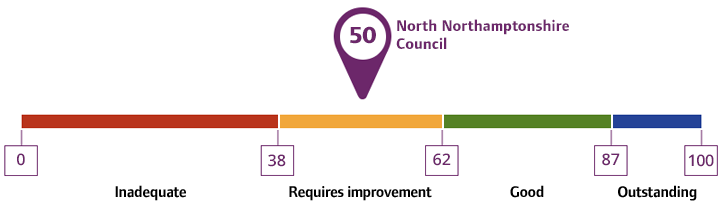
Local authority rating and score
Quality statement scores
Summary of people’s experiences
Feedback gathered from people engaging with adult social care services in North Northamptonshire was mixed. People reported having regular contact with practitioners, receiving tailored support, and benefiting from clear and consistent communication. Assessments were described as comprehensive, with consideration given to risks such as social isolation.
According to the Adult Social Care Survey 2023/24, 66.37% of people in North Northamptonshire expressed satisfaction with their care and support. This figure was similar to the England average of 65.39%, suggesting broadly comparable levels of satisfaction across the region.
People raised concerns about waiting times within adult social care. People reported delays in accessing assessments, including therapy assessments which in turn led to prolonged waits for the provision of equipment. People said this had potential to impact on their ability to maintain independence and manage daily living tasks effectively.
Feedback from carers was mixed. Some described the support they received as person-centred and strength-based, with a comprehensive offer that met their needs. However, others reported challenges, particularly around contingency planning, and the accessibility of residential respite services.
Feedback regarding access to information, advice, and guidance was also mixed. Some people felt they had good access to relevant resources, others described experiencing barriers. These included limited availability of information for people whose first language was not English and a lack of adapted formats such as easy-read materials, which affected accessibility for some people.
Participation in coproduction was noted by a number of people, with some reporting involvement in specific aspects of service development. However, there was a degree of confusion regarding the nature of their role in coproduction. Some people expressed a desire for greater clarity and more opportunities to contribute meaningfully, particularly at earlier stages of service design and planning.
Summary of strengths, areas for development and next steps
Adult social care in North Northamptonshire was delivered through a strengths-based, person-centred approach that aligned with the local authority’s “Moving Forward with Place” agenda. This strategic direction supported inter-agency collaboration and aimed to embed care within broader community frameworks.
Despite this commitment to personalised care, assessments and care planning were not consistently timely or up to date. At the time of review, 311 people were awaiting Care Act assessments and 1481 were awaiting reviews. The local authority recognised these delays and was actively working to reduce waiting lists and improve responsiveness.
Support for carers was provided through a commissioned voluntary, community, and social enterprise (VCSE) organisation, offering a comprehensive range of services. However, oversight of service quality and data was limited. Access to residential respite and carers’ direct payments remained limited, and local authority staff lacked awareness of the carers’ offer.
To prevent escalation of need, the local authority launched initiatives such as Support North Northamptonshire (SNN), a multi-agency programme designed to connect people with early support. This involved voluntary sector partners and used a strengths-based approach to guide people to appropriate pathways before statutory intervention was required. Progression workers and Age Well workers supported people regardless of eligibility status, helping to bridge gaps in early intervention.
Intermediate care and reablement services were delivered in partnership with health providers and voluntary organisations. These services aimed to promote independence and reduce reliance on long-term care. Key provisions included bed-based reablement at Thackley Green and a purpose-built facility in Corby.
People were able to access equipment and minor home adaptations to support independent living, though delays in provision sometimes impacted their effectiveness. Accessibility of services also varied. While some aspects were inclusive for people with differing support needs, this was not consistently applied for those requiring adapted communication or information in languages other than English.
The local authority had begun work to identify and engage under-represented groups, commissioning a voluntary organisation to support community-level understanding and provision. There was opportunity to strengthen evaluation frameworks to ensure equity in access and support. Further development of data integration into service delivery was required to understand and meet the needs of seldom heard and under-represented communities.
Commissioning decisions were informed by a wide range of local intelligence, including insight packs, Joint Strategic Needs Assessment (JSNA) data, and partnership profiles. These tools enabled the local authority to identify key indicators such as public health outcomes, employment patterns, deprivation levels, and demographic projections. While efforts were made to improve care provision capacity, challenges remained in meeting full demand. Recommissioning and restructuring created additional capacity, particularly in homecare, but delays persisted in residential placements, especially for hospital discharge, mental health, and dementia services.
A structured approach was in place for monitoring the quality and impact of commissioned services. The local authority used defined quality outcomes, contractual compliance measures, and a regulated framework to assess services. These arrangements were consistent across internal, external, and out-of-area contracts and were supported by proactive monitoring systems, including risk matrices, review cycles, and collaborative oversight mechanisms.
Partnership working supported shared outcomes through integrated initiatives such as the ‘Home First’ model and the intermediate care unit at Thackley Green. The local authority participated in collaborative forums, including the Mental Health, Learning Disability and Autism (MHLDA) Collaborative, aligning with system-wide governance structures. However, joint working arrangements were not consistently monitored or formally reviewed and lacked defined strategic frameworks.
Protocols were in place to support transitions into adulthood and from hospital settings. Dedicated workers facilitated these processes, and continuity plans were established for service disruptions and out-of-hours support. Safeguarding policies and procedures were detailed and locally tailored. The local authority worked with the Safeguarding Adults Board to identify and mitigate risks of abuse and harm, although there were challenges in the consistency and timely management of safeguarding concerns.
Governance frameworks were structured, with several strategic initiatives either newly implemented or in development. This limited the extent to which impact could be reviewed or evaluated. Strategic planning was further hindered by fragmented data infrastructure. A culture of continuous learning and improvement was evident, with support for professional development. Staff had access to ongoing training, and co-production was beginning to take shape, with a clear commitment from the local authority to embed it more fully in future practice.